

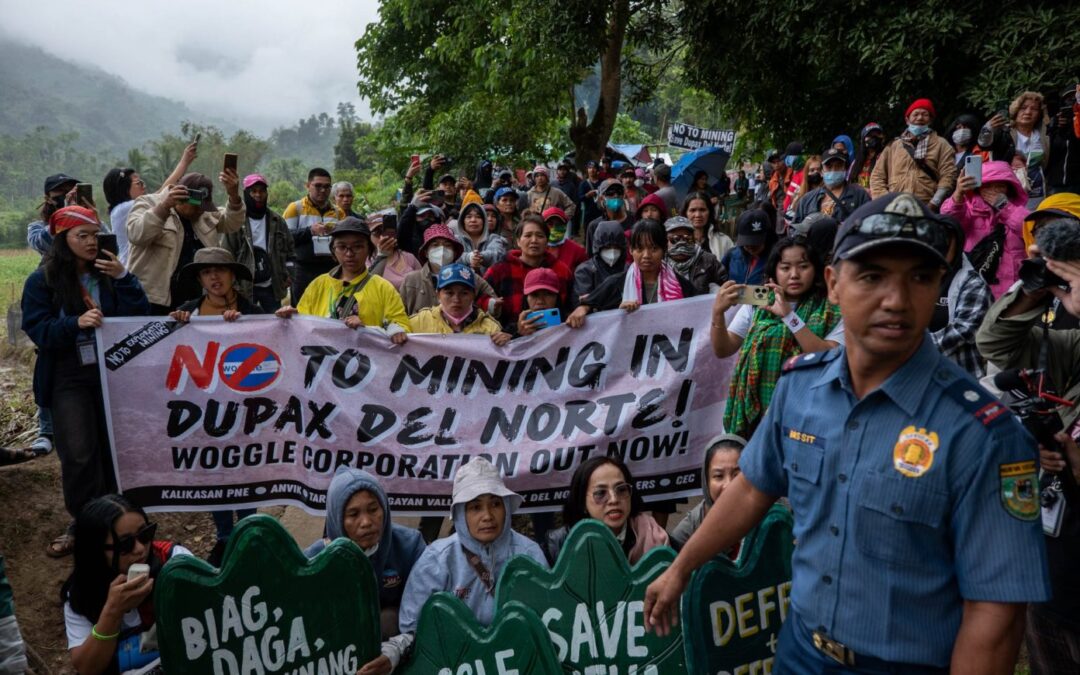
Environmental advocates and community leaders in the Philippines’ Quezon province launched a three-day protest walk on Nov. 17 to oppose coal, extractive and controversial renewable energy projects they say are deepening local climate risks amid escalating global calls for climate justice.
“Greed invites human-made disasters, which the innocent, poorest communities are mostly suffering. And we want those corporations, in collusion with concerned government bodies, to realize that they are not solely taking profits, but lives”, said Rev. Fr. Warren Puno, convenor of Quezon for Environment (QUEEN).
Fr. Puno said the protest walk is an act of solidarity with communities repeatedly hit by severe weather and climate-induced disasters.
“This is also to raise awareness that many people are being harmed and even dying because of projects that destroy the environment. We will be passing through areas where there are destructive and dirty energy projects,” he said.
The Lakad-Panaghoy Para sa Sangnilikha, organized by QUEEN, runs from Nov. 17 to 19 through Mauban, Tayabas City, Pagbilao, and Atimonan.
The three-day march follows a 50-kilometer route beginning at St. Bonaventure Parish in Mauban, passing through Our Lady of the Visitation Parish and the Minor Basilica of St. Michael the Archangel in Tayabas City, then St. Catherine of Alexandria Parish and St. Anne Parish in Pagbilao, before concluding in Atimonan, where several contested energy projects are located.
The coalition said the march seeks “a true solution to the ecological crisis,” pointing to projects that “systematically impede social and ecological justice.”
Bishop Gerardo Alminaza of San Carlos, incoming president of Caritas Philippines, expressed full support for the communities and groups taking part in the march, saying it reflects both moral courage and compassion for those most at risk.
“Your walk is not only a protest but also a prayer, a sacrifice and a courageous stand for creation and for the most vulnerable,” he said.
The protest coincides with COP30 in Belém, Brazil, which QUEEN said underscores the gap between global climate negotiations and the ongoing approval of developments they describe as climate-exacerbating.
A longstanding concern raised during the march is Meralco PowerGen’s proposed 1,200-MW coal-fired power plant in Atimonan, which organizers described as “a big thorn to communities that they fought for a decade.”
They argue the project is an unnecessary addition to the province’s “coal capital” reputation.
QUEEN also voiced strong objections to the Ayala Group’s 247-MW Banahaw Wind Power Project inside the sacred and protected Mt. Banahaw landscape.
While acknowledging the need for renewable energy, the group warned that a rising number of what it calls “destructive RE” projects are being sited in ecologically sensitive areas.
Extractive operations elsewhere in Quezon, they added, continue to heighten disaster risks in communities already exposed to extreme weather.
The coalition criticized government agencies that have allowed these developments to proceed, saying regulators “now play a significant role in the expedition of most environmentally-destructive projects’ greenlighting.”
The protest unfolded as Luzon and the Visayas continue to recover from Typhoon Tino (Kalmaegi) and Supertyphoon Uwan (Fung-Wong), which “withdrew nearly 300 lives, causing billions of pesos in damage, displacing millions of communities” in the first half of November.
“Doing nothing in the middle of a human-made crisis is like watching a massacre without even showing a piece of grimace”, said Msgr. Emmanuel Ma. Villareal, a Quezonian priest and environmental advocate.
0 Comments