

Pro-environment and rights groups on Saturday demanded that the Philippine government “dismantle repressive mechanisms” that, they argued, “fuel a climate of fear and impunity.”
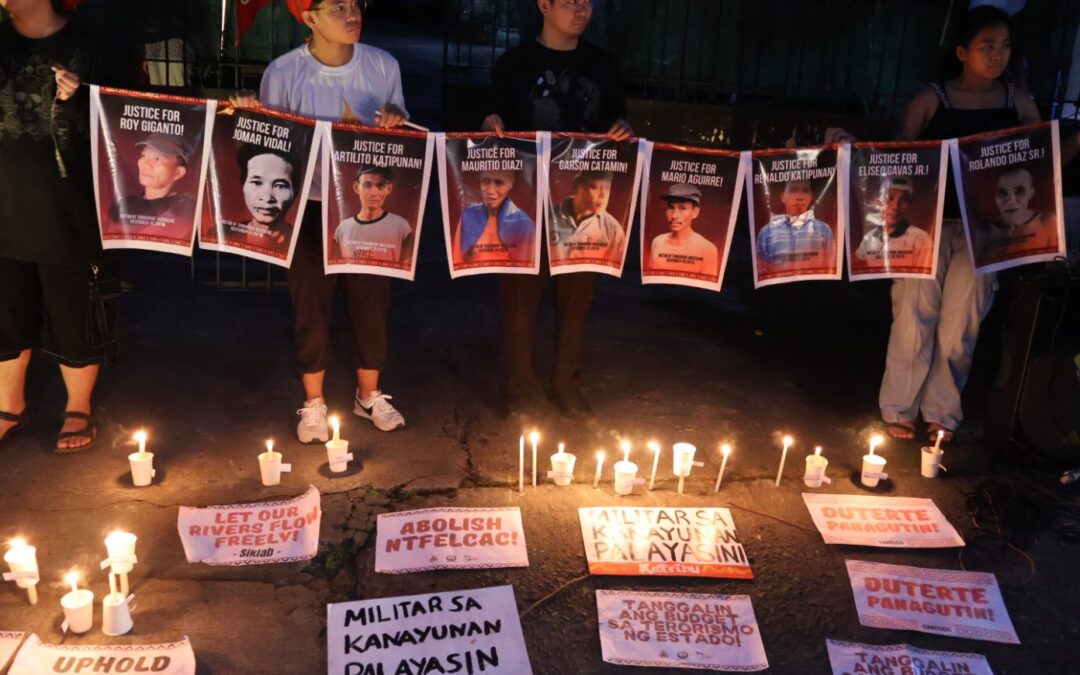
The groups issued the statement during the observance of the International Day of Victims of Enforced Disappearances on August 30.
Panatang Luntian noted that 14 out of 15 documented cases of enforced disappearances under the administration of President Ferdinand Marcos Jr. involve environmental defenders and human rights activists.
“The majority of these violations occur around large infrastructure projects such as mining, dam, and reclamation projects, often targeting Indigenous peoples, peasants, and activists who are defending land, seas, and people’s rights,” the group said.
It also said the disappearances “are not isolated incidents,” but instead “reflect a systematic pattern of state repression” against environmental and human rights defenders.
The group cited the cases of abduction survivors Jonila Castro and Jhed Tamano, who were abducted in September 2023, and Eco Dangla and Jak Tiong, who were taken in March 2024.
Castro and Tamano, who were initially presented as “rebel returnees” in a government-led press briefing, “testified that they were forcibly taken, coerced into fabricating false narratives, and subjected to psychological and physical torture,” the group said.
Panatang Luntian insisted that the government end the “weaponization of abduction as a tool of state repression” and “hold accountable all those responsible for abductions.”
Rights groups Karapatan and Desaparecidos (Families of Desaparecidos for Justice) warned that enforced disappearances persist despite laws meant to protect victims and their families.
They also decried the lack of urgency in issuing writs designed to provide swift judicial remedies and to compel state forces to investigate cases and inform families.
“In fact, when families of the disappeared seeking protective writs from the courts receive favorable rulings, the courts invariably lambast the military and police for failing to exercise extraordinary diligence in searching for the missing victims,” the groups said.
The rights groups described the State’s failure to comply with its obligations under domestic and international human rights instruments as “a glaring manifestation of complicity.”
0 Comments